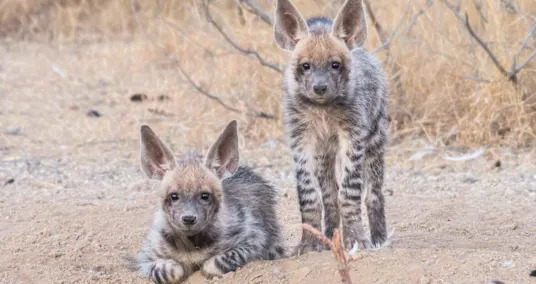
The post This Overlooked Predator Is Running Out of Time—Why Conservationists Are Racing to Save the Striped Hyena appeared first on A-Z Animals.
Quick Take
Only 5,000 to 9,999 striped hyenas remain worldwide, with populations declining drastically across much of their range.
The Wildlife Conservation Society is urging global leaders to list the species under the Convention on Migratory Species for stronger protections.
Habitat loss, human conflict, and illegal killing are driving these hyenas into isolated, vulnerable populations.
If adopted, a proposed dual CMS listing could enforce stricter protections and improve the prospects for isolated, vulnerable populations.
The Wildlife Conservation Society (WCS) is sounding the alarm for one of the world’s most overlooked carnivores: the striped hyena (Hyaena hyaena). Once widespread across parts of Africa, Asia, and the Middle East, this adaptable scavenger is now slipping into a quiet decline, with fewer than 10,000 mature individuals estimated to remain in the wild.
At the CMS CoP15 (15th Meeting of the Conference of the Parties), WCS is urging governments to grant the striped hyena dual protection under the Convention on the Conservation of Migratory Species of Wild Animals (CMS). Although the species is currently listed as “Near Threatened” on the IUCN Red List, that broad classification masks severe regional collapses and gives a false impression of security. A formal CMS listing, if adopted, would replace this ambiguity with stronger legal safeguards and much-needed international coordination.
Across a range that stretches from Lebanon to Tajikistan and Nepal, striped hyenas are being pushed into smaller, fragmented pockets of habitat. With population data still patchy and declining trends accelerating, conservationists argue that waiting for certainty is no longer an option. Without coordinated, cross-border protections, this highly mobile predator could quietly disappear across the majority of its historical territory.
An Overlooked Ecosystem Engineer
The striped hyena is the smallest — and perhaps the least understood — of the hyena species. Weighing roughly 77 pounds, it lacks the massive build and complex social drama of the famous spotted hyena (Crocuta crocuta). Instead, it leads a low-profile life, often solitary or paired in monogamous couples. It is most active under the cover of night and notoriously elusive across its range.

Striped hyena pups nurse for at least a year.
©Vladislav T. Jirousek/Shutterstock.com
Although primarily scavengers, striped hyenas are also capable hunters when the situation demands it. Their opportunistic adaptability allows them to thrive in some of the harshest landscapes on Earth. Unfortunately, this quiet persistence also means they are often overlooked in favor of more “charismatic” predators like lions or leopards.
Despite its modest reputation, the striped hyena provides a vital service to its environment. By consuming carcasses and organic waste, they prevent the spread of disease and pathogens that linger in rotting remains. They also break down waste and return essential nutrients back into the soil. In many arid regions, they are the primary scavengers, quietly maintaining the health of the entire habitat and protecting the ecological balance.
A New Legal Shield
Because striped hyenas can travel over 7 miles daily and disperse across distances of nearly 50 miles, they routinely cross national borders. As a result, isolated national protections are no longer enough. To address this, Tajikistan and Uzbekistan, with support from WCS, have proposed placing the species under dual international protection: Appendix I and Appendix II of CMS.
The proposed dual listing would establish two pillars of protection:
Appendix I (Strict Protection): Mandates that member states prohibit the killing or capture of the species and prioritize the restoration of critical habitats.
Appendix II (International Coordination): Compels range countries to collaborate on shared conservation strategies, ensuring that protection remains seamless across political borders.

When threatened, striped hyenas raise the hair along their backs to look much larger than they actually are.
©Dr. Meet Poddar/Shutterstock.com
While the “Near Threatened” label suggests a safety net, the reality is a continuous decline. In Tajikistan, the striped hyena is already Critically Endangered, with an exceptionally small and fragile population. WCS argues that acting now — rather than waiting for a global “uplisting” — is the only way to prevent irreversible extinction.
A Species Under Pressure
Striped hyenas face consistent human-driven threats across their diverse range. At the core of these challenges are human-wildlife conflict and habitat loss.
Human-Wildlife Conflict and Cultural Stigma
Retaliatory killing remains perhaps the most immediate threat to the species. Driven by real or perceived risks to livestock, hyenas are frequently poisoned, shot, or driven from their dens. In Tajikistan, they are often branded as agricultural pests and targeted with widespread poisoning. Poisoned bait in Nepal has become the leading cause of mortality in human-dominated landscapes. In Lebanon, the compounding pressures of economic instability and active conflict have eroded local tolerance for predators like hyenas, leading to a surge in retaliatory strikes.
Habitat Fragmentation and “Empty Forests”
Rapidly expanding infrastructure, agriculture, and border defenses are rapidly shrinking viable habitats and migratory routes. In Lebanon, warfare has devastated the olive groves and pastures that once supported a healthy ecosystem, stripping scavengers of their food sources. Similarly, in Tajikistan’s Khatlon region, extreme habitat loss has trapped a tiny population into disconnected pockets of wilderness.

The striped hyena is the national animal of Lebanon.
©Stu Porter/Shutterstock.com
Illegal Trade and Food Scarcity
Beyond physical displacement, striped hyenas are also targeted for their body parts for use in traditional practices, even where legal protections exist. A collapse in natural prey further compounds the issue. As habitats are destroyed and degraded, hyenas are forced closer to human settlements in search of food — a desperate move that only intensifies the conflict.
Local Solutions with Global Implications
To save striped hyenas, conservationists are shifting toward community-based models that protect dwindling populations through local empowerment. A primary example of this is in Tajikistan, where the species was rediscovered in 2016 after being presumed locally extinct for decades.
In the Khatlon regions, NABU and the Tajikistan Nature Foundation have moved beyond simple monitoring to launch active recovery projects. Recruiting mountain dwellers into “Local Information Teams” fosters a sense of stewardship over the fewer than 30 hyenas left in the area. Grassroots efforts also include school programs that debunk harmful cultural myths and a food restoration strategy involving Russian olive trees. Planting these trees provides a natural food source, steering hyenas away from human settlements and melon crops.

Striped hyenas have distinctly striped coats and long manes along their backs.
©Katoosha/Shutterstock.com
Why National Parks Aren’t Enough for Striped Hyenas
Over two decades of research in Nepal shows that traditional National Parks are no longer sufficient on their own. Although populations remain relatively stable within the safety of the park boundaries, hyenas living in unprotected areas are rapidly disappearing. Experts are pushing for “functional connectivity” to protect wild corridors. This allows isolated groups to travel, meet, and breed across fragmented landscapes. This modern approach necessitates a shift toward conservation models that actively partner with the local communities living alongside these predators. Dedicated national action plans could finally bring the striped hyena the same funding and attention granted to more “charismatic” species like tigers.
CITES currently lists the striped hyena in Appendix III for the Botswana population, but there have not been new, stricter global restrictions on international trade of hyena body parts as of March 2026.
Connectivity as the Key to Survival

Although striped hyenas mainly scavenge carrion, they also eat insects, fruits, and small animals.
©RealityImages/Shutterstock.com
The future of the striped hyena depends on a fundamental shift toward global cooperation rather than relying on isolated local laws. Because these predators frequently cross national borders, individual country policies are no longer enough to protect them. Formally listing the species under CMS Appendix I and II would enforce strict legal protections, restore vital habitats, and mandate international data sharing.
Although the striped hyena has survived for centuries, its legendary resilience is finally reaching a breaking point. From the disappearing olive groves of Lebanon to the shrinking wilderness of Nepal and Central Asia, the warning signs of their collapse are clear. Without an immediate, united rescue effort, this often-overlooked species faces a quiet slide toward extinction.
The post This Overlooked Predator Is Running Out of Time—Why Conservationists Are Racing to Save the Striped Hyena appeared first on A-Z Animals.
LATEST POSTS
- 1
 Top 20 Wellbeing and Wellness Applications for a Sound Way of life
 - 2Swap The Amalfi Coast For This Low-Cost Ligurian Seaside Town
- 3South Carolina's measles outbreak reaches 434 cases
- 4Famous Versatile Brands: Your Decision
- 5Russia provided Iran with list of Israeli energy targets, Ukrainian intelligence finds





- The Job of Attorneys: It is Important to Comprehend When Legitimate Help
- Instructions to Pick the Right Senior Protection Plan.
- FOX8 Meteorologist Charles Ewing makes his 2025-26 winter weather predictions!
- The largest sun of 2026 rises today as Earth draws closest to our parent star
- How did life begin on Earth? New experiments support 'RNA world' hypothesis
- Crypto Investor’s Family Tied Up and Beaten by Armed Gangs in Their Home
- Ukraine Now Using Drone Boats To Attack Russian Riverine Targets
- Careful Living: Embracing the Current Second
- The top astronomical discoveries of 2025