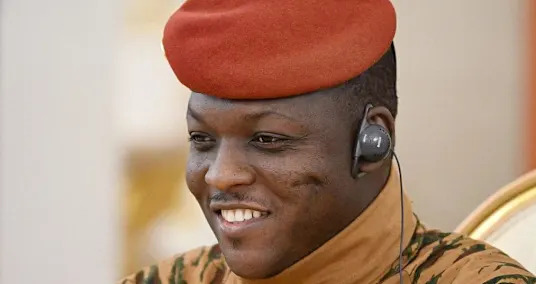
More than 1,800 civilians have been killed in Burkina Faso since Ibrahim Traoré seized power three years ago in acts amounting to "war crimes and crimes against humanity", a new report says.
Human Rights Watch (HRW) says about 1,837 civilians, including dozens of children, were killed in 57 incidents between January 2023 and August 2025.
It attributes most of the killings - 1,255 - to the military and allied militias, with the rest blamed on Islamist militants.
HRW finds President Traoré and six senior military commanders "may be liable as a matter of command responsibility for grave abuses and should be investigated". It also says five jihadist leaders may be culpable.
The Burkinabé authorities have not yet commented on the report but have dismissed previous accusations that their forces have killed civilians.
One of the reasons the military gave for seizing power was to tackle the jihadist groups linked to al-Qaeda who have been waging an insurgency in Burkina Faso and neighbouring countries for over a decade and control huge parts of the country.
The report is based on analysis of open-source information, including photos, videos and satellite imagery, and interviews with witnesses and survivors.
"All sides are responsible for the war crimes of willful killing, attacks on civilians and civilian objects, pillage and looting, and forced displacement," the report says.
It accuses the junta of committing "horrific abuses" and failing to hold perpetrators to account while blocking reporting to hide the suffering of civilians caught in the violence.
"The scale of atrocities taking place in Burkina Faso is mind-boggling, as is the lack of global attention to this crisis," says Philippe Bolopion, HRW's executive director.
The report cites one of the deadliest incidents in December 2023 in which it says the military and allied militias killed more than 400 civilians in the northern town of Djibo.
A 35-year-old woman told the rights group that her two daughters died on the spot and bullets injured her and her nine-month-old son.
"Make sure no-one is breathing before heading out," she recounted a militia member as saying.
Survivors described the killings as brutal and said they continue to suffer deep psychological trauma.
"Many survivors described the killings as 'butchery' and said they were left with deep psychological wounds," the report notes.
The militias allied with the military are the so-called Volunteers for the Defence of the Fatherland (VDP) - civilians recruited by the junta to support the army's fight against jihadist groups.
The junta has been accused of forcing critics to join the group to punish them.
Traoré has previously defended conscription, saying that "individual freedoms [are] not superior to national freedom" and that "a nation is not built on indiscipline and disorder".
Since the military government seized power, authorities have been accused of carrying out brutal campaigns increasingly targeting civilians in response to attacks by al-Qaeda affiliate JNIM, the biggest jihadist group in the country.
Civilians described to HRW a feeling of being "caught between a rock and a hard place", threatened with death by JNIM while also being targeted by government forces.
The rights group says JNIM has used widespread threats and violence to dominate and punish communities and has targeted civilians refusing to submit to its authority, whom it accuses of supporting the government.
In August 2024, JNIM attackers "shot dead at least 133 people and injured more than 200 in fewer than two hours", it says.
HRW is now urging the International Criminal Court to open a preliminary investigation into the alleged crimes committed by all the parties since September 2022.
It has also called on Burkina Faso's partners and donors to impose sanctions and to refrain from cooperating with the country's army.
Traoré seized power in September 2022 after overthrowing Paul-Henri Sandaogo Damiba, who had taken over only nine months earlier.
Despite his authoritarian reputation, 37-year-old Traoré has gained a huge following across the continent for his pan-Africanist vision and criticism of Western influence.
Burkina Faso, like its neighbours Mali and Niger which are also under military rule, has moved away from working with Western countries, especially France, in its fight against the Islamist groups. All three have instead turned towards Russia for military assistance, however the violence has continued unabated.
You may also be interested in:

Go to BBCAfrica.com for more news from the African continent.
Follow us on Twitter @BBCAfrica, on Facebook at BBC Africa or on Instagram at bbcafrica
BBC Africa podcasts
LATEST POSTS
- 1
 Tech giants accused of not complying with Australian social media ban
 - 2One third of Spanish pork export certificates blocked since swine fever outbreak, minister says
- 36 U.S. States for Climbing
- 4Find the Standards of Viable Nurturing: Supporting Blissful and Strong Kids
- 5BHP liable for 2015 Brazil mine disaster: UK court


- Find Unexpected, yet invaluable treasure Excursion Rentals
- Figure out How to Take part in Open Conversations Around 5G Pinnacles
- Deaths reported in Lebanon as Israel and Hezbollah exchange attacks
- Drones, physics and rats: Studies show how the people of Rapa Nui made and moved the giant statues – and what caused the island’s deforestation
- Figure out how to Team up with Your Auto Crash Legal advisor for Best Outcomes
- Flu is rising rapidly, driven by a new variant. Here's what to know
- Is new Harry Styles music on the way? Fans think so, after a cryptic website and posters pop up.
- 5 Morning Schedules That Stimulate Your Day
- Fake new headlights rule steer Australian drivers astray