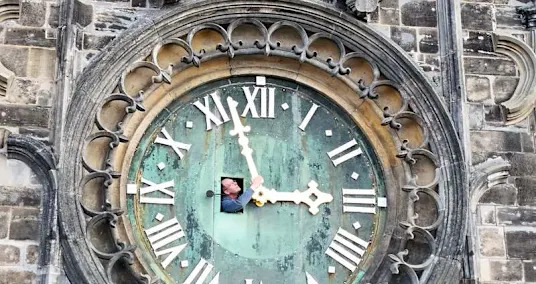
Clocks across the majority of European countries are set to go forward by one hour early on Sunday as the continent moves to daylight saving time, also known as summer time.
Clocks in most European nations including Germany advance by one hour at 2 am (0100 GMT) to 3 am, heralding longer evenings and brighter days.
This means that for the coming months parts of Europe will be on Central European Summer Time (CEST), before moving back to Central European Time (CET) in the autumn, when clocks go back again by an hour on October 25.
The aim of the change is to make better use of daylight in the shorter days of the winter in the northern hemisphere.
The signal for the automatic changeover of the clocks in Germany comes from the Federal Institute of Physics and Metrology (PTB) in the northern city of Braunschweig, also known as Brunswick in English.
The institute's experts ensure that radio-controlled clocks, station clocks and many industrial clocks are supplied with the signal via a long-wave transmitter called DCF77 in Mainflingen near Frankfurt.
LATEST POSTS
- 1
 Every year, she thanks the trooper for the arrest that led to her sobriety
 - 2The Specialty of Cleaning up: Change Your Space and Brain
- 3An Ideal Getaway - Spots for Solo Travel
- 4Senior's Manual for Obtaining a Hyundai Ioniq EV: Tips
- 5The year's first meteor shower and supermoon clash in January skies


- Find the Marvels of the World with These Travels
- NASA Perseverance rover sees megaripples on Mars | Space photo of the day for Jan. 7, 2026.
- Figure out how to Consolidate All encompassing Practices with a Degree in Brain research
- Fiber is something most people could use more of. But experts advise caution with 'fibermaxxing'
- Brexit's Effect on New York's Ascent as a Main Monetary Center
- The most effective method to Guarantee Scholastic Honesty in Web-based Degrees
- Africa's energy giants eye long-term gains on Iran war disruption
- Exemplary Fragrances: A Manual for Notorious Scents
- Former ‘Dancing with the Stars’ Pro Survives Plane Crash at LaGuardia That Left 2 Pilots Dead