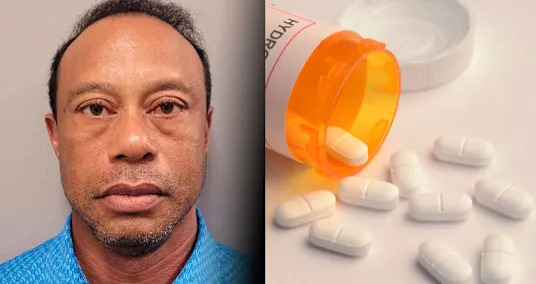
After colliding with a truck and overturning his vehicle, Tiger Woods passed a breathalyzer test — it showed he had 0.00% alcohol on his breath — but was still arrested on suspicion of driving under the influence, according to a police report released Tuesday. (Woods pleaded not guilty.) The report described him as lethargic, with bloodshot eyes and dilated pupils. Woods said he had taken prescription medications that morning, and officers later found two tablets of hydrocodone, a painkiller, in his pocket.
Alcohol isn’t the only substance that can cause impaired driving — drugged driving is a growing concern among public health experts. It’s unclear if hydrocodone was one of the prescriptions Wood had taken earlier that day, but the powerful painkiller can make driving more dangerous.
What is hydrocodone?
Hydrocodone is a prescription synthetic opioid, a highly effective but addictive painkiller. It’s short-acting — typically lasting four to six hours — and is considered less potent than its cousin, oxycodone, or the extended-release drug, OxyContin.
The drug works by attaching to opioid receptors in the brain, mimicking the pain-blocking effects of the body’s natural endorphins. Like these “feel good” hormones, opioids can cause a sense of euphoria.
But hydrocodone and its opioid relatives come with serious risks. Taken at too high a dose, an opioid can depress, or slow down, breathing and heart rate, which can be fatal. Because they’re addictive, they’re also prone to misuse. Prescription opioids, especially oxycontin, helped fuel the onset of the U.S. opioid addiction and overdose crisis. People who were prescribed opioids became dependent on them, developed tolerances — meaning they needed to take higher doses or stronger drugs to obtain the same effects — and in some cases turned to dangerous, illicit opioids like heroin and fentanyl. At the peak of the opioid epidemic, in 2022, more than 100,000 people died from overdoses.
“For years, especially in the ‘90s and early 2000s, hydrocodone was viewed as safer than other opioids,” Andrew Yockey, an assistant professor of public health at the University of Mississippi who has studied the role of drugs in traffic accidents, tells Yahoo. “Because it was considered less potent and less addictive — though we all now know that was incorrect — it made physicians very comfortable treating things like acute back pain or injury.” As awareness of hydrocodone’s addictive potential grew, it was reclassified from a Schedule III to a Schedule II narcotic by the Drug Enforcement Administration (DEA).
Today, hydrocodone is still one of the most commonly prescribed painkillers. It’s often the drug of choice for mild-to-moderate pain after surgery. But it’s only intended to be taken for a matter of days or weeks in most cases, says Yockey. “After six weeks to a few months, it’s [considered] a chronic condition, that’s where a different drug is indicated.” Woods had back surgery to replace a damaged disc in his spine in October to alleviate pain and mobility issues. It’s unclear if the prescription drugs in his pocket were related, but “if Tiger had surgery back in October, he shouldn’t be on hydrocodone for six months — that is just not OK,” says Yockey.
Drugged driving is on the rise
Along with its addictive and euphoric effects, hydrocodone can also cause drowsiness, blurred vision and mood changes. “It’s not recommended to drive [on hydrocodone], typically because there can be some cognitive impairment and amnesia, and a person can get confused. Plus, it has some effects on the eyes and vision,” Dr. Denis Antoine, a Johns Hopkins addiction psychiatrist, tells Yahoo. Adds Yockey: “Essentially, [reaction] time slows down.”
Certain drugs can make driving significantly more dangerous. More than half of fatal accidents in 2020 involved some form of drug. And some research suggests that as drunk driving incidents are declining, so-called drugged-driving ones are increasing. The vast majority of these involve cannabis, according to Yockey’s own analysis. But he estimates that opioids are a factor in as many as 7% of driving-while-impaired incidents.
Hydrocodone’s label warns against driving or operating heavy machinery, but Yockey suspects many doctors don’t adequately advise their patients about the risks. Though it’s relatively rare that opioids cause impaired driving accidents on their own, Yockey and Antoine both note that the medications are particularly dangerous when combined with alcohol, other drugs (such as cannabis or cocaine) and fatigue.
What to know if you’re prescribed hydrocodone
Experts say patients should avoid driving until they understand how hydrocodone affects them, which can take several days. And don’t drink alcohol while taking the medication; the combination can depress the nervous system more than either substance on its own, raising the risk of a life-threatening overdose.
Take hydrocodone only as long as your doctor advises. For many people, that’s just a few days to help manage acute pain after surgery or injury, says Yockey. If you’re taking a longer course, Antoine suggests working with your prescriber to taper down your dose before going completely off the medication.
LATEST POSTS
- 1
 The Advancement and Effect of Dental Embed Innovation on Oral Wellbeing
 - 2Step by step instructions to Choose the Right Auto Crash Legal counselor for Your Case
- 3Find Exemplary Scents: An Extensive Aide
- 4A Manual for Pick High Evaluated Food Conveyance Administrations In Significant Urban communities For 2024
- 5Travel Through France's Most Iconic Wine Regions By Train On An Immersive Seven-Day Journey





- Opening Innovativeness: Moving Thoughts and Tasks
- The Tiny Channel Island With 65 Residents That Chefs And Foodies Go Out Of Their Way To Visit
- Whale stranded off Germany for days free again
- Native Americans had dice and games of probability long before other cultures, study finds
- Ski Resorts Universally: A Colder time of year Wonderland Guide
- Woman charged in unprovoked stabbing of tourist changing baby's diaper in Macy’s Herald Square store
- Ukraine's new defense minister just outlined how dire its troop shortage has become
- Why home maintenance deserves a spot in the annual health and budget plans
- ‘Nahariya get ready’: Banner displaying Hezbollah threat mounted in Tehran’s Palestine Square