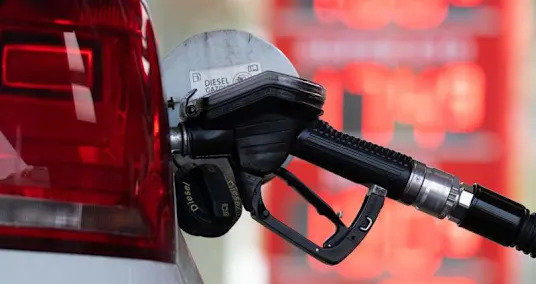
Hours after Germany's upper house of parliament, the Bundesrat, approved a package of measures to curb high fuel prices, President Frank-Walter Steinmeier signed plan into law on Friday.
The bill officially takes effect once it is published in the Federal Law Gazette. The package of measures had only been passed by the Bundestag, or lower house of parliament, on Thursday.
Ahead of the busy Easter travel period, the new law allows petrol stations to raise prices only once per day, at noon (1100 GMT).
Previously, fuel prices were changing sometimes hourly, due to the US-Israeli war in Iran. Price cuts, however, will still be possible at any time.
In addition, Germany's competition authority is to receive more powers to act against excessive prices. In future, companies will have to explain that price increases are objectively justified.
This is intended to make it significantly easier for regulators to take action against excessive fuel pricing.
Whopping 80% say law is inadequate
Although by German standards the law passed very quickly, residents are not impressed.
A clear majority of people in Germany believe the government's measures against rising fuel prices are inadequate, with 80% of respondents surveyed saying not enough is being done, the ZDF's Politbarometer poll released on Friday showed.
Some 14% consider the measures appropriate while 3% say they go too far.
Many people are calling for a temporary cut in taxes and levies on petrol and diesel, the survey found. Some 73% support such a step while 25% oppose it. That's backed by a majority across most party supporters, with only Green party supporters showing a split picture.
LATEST POSTS
- 1
 Smooth countdown continues for Artemis II moon mission
 - 2The Golden Globes is happening Sunday: Who's nominated, who's hosting and how to watch
- 3Fact Check: Israeli Channel 13, Al Jazeera Did NOT Confirm Hezbollah Captured All Or Part Of Kiryat Shmona
- 4Top Frozen yogurt Flavor: Cast Your Vote!
- 5Manual for Purchasing a Modest Jeep Wrangler for Seniors





- Burkina Faso forces killed twice as many civilians as jihadists, rights group says
- Saturn shines with the waxing moon at sunset on Nov. 29
- Hamas set to elect new terror leader with Hayya, Mashaal in pole position
- BravoCon 2025: How to watch, full schedule and lineup, where to stream free and more
- 19 Strange Motion pictures You Shouldn't Watch With Your Mum
- Fire Allegedly Triggered by Wedding Cake Sparkler Causes Venue to Go Up in Flames, Leaving Groom with Second-Degree Burns
- Have gravitational waves provided the first hint of primordial black holes born during the Big Bang?
- Dutch police probe a small blast outside a pro-Israel Christian center
- Former 'Bachelorette' welcomes 1st baby via emergency c-section