When you buy through links on our articles, Future and its syndication partners may earn a commission.

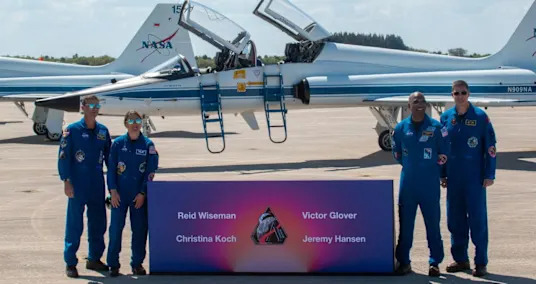
CAPE CANAVERAL, Fla. — The crew of Artemis 2, NASA's first launch to the moon in over half a century, has arrived at the Kennedy Space Center ahead of their mission.
NASA astronauts Reid Wiseman, Victor Glover and Christina Koch, and Canadian Space Agency (CSA) astronaut Jeremy Hansen piloted T-38 jets from the Johnson Space Center in Houston to touch down on the runway at KSC's Shuttle Landing Facility at 2:15 p.m. EDT (1915 GMT) today (March 27), here on the Space Coast.
The quartet are poised to launch aboard NASA's Space Launch System rocket (SLS) as soon as April 1, and will fly the agency's Orion spacecraft on a 10-day mission around the moon and back to Earth. It's the first crewed mission of NASA's Artemis program to establish a sustained human presence on the moon, and the first to launch astronauts there since Apollo 17, in 1972.
The crew have been in quarantine since March 20, when SLS was rolled from KSC's Vehicle Assembly Building (VAB) to the pad at Launch Complex-39B (LC-39B). Now at their last terrestrial stop before heading to space, the Artemis 2 astronauts will remain in quarantine through the remainder of the mission's upcoming launch window, which extends through April 6.
It was the second such rollout for the Artemis 2 SLS, which NASA was forced to roll the rocket back to the VAB from the pad after its initial rollout earlier this year due to maintenance issues discovered during prelaunch tests in February.
Artemis 2 is designed as a stepping stone for the Artemis program, and will test Orion's life support systems in space with astronauts aboard for the first time. The crew won't land on the moon during Artemis 2, but will instead fly in a loop around its far side on a course known as a free-return trajectory. This is a path that flies Orion to lunar space on a direct path back to Earth to avoid the need for any major firings of the spacecraft's engine after its translunar injection burn that will put it on a course for the moon.
Assuming no major issues crop up during the Artemis 2 mission, NASA is planning a demonstration with Orion and the Artemis lunar landers to take place on Artemis 3 in Earth orbit next year. Following that, and pending the readiness of one of those landers, the agency is aiming for the program's first lunar landing on Artemis 4 in 2028. Beyond that, NASA hopes to begin laying the architecture for a more permanent lunar presence through the 2030s with habitats, rovers and regular cargo landers to establish a sustained outpost on the moon's surface.
"We're not trying to get it right out of the gate," Isaacman said to media after the astronauts' arrival. "In fact, it's a test and experimentation phase — lots of rovers, lots of landers ... That means lots of opportunity for scientific and technological payloads that we can incorporate."


"It's awesome to be here. We love coming here," Wiseman said on the tarmac on Friday afternoon. "About 100 miles away, we said how much we love sliding to KSC."
In his remarks, Wiseman also thanked members of NASA's astronaut office for their support. "I just want to send a special thank you to our AOD team. They pulled a lot together to make this possible for us to get to fly these jets and stay in quarantine and have all the support," he said.
If NASA's schedule holds, the Artemis 2 crew will transfer to KSC's Neil Armstrong Operations and Checkout facility (O&C), appropriately named for one of the first human to walk on the moon, early Wednesday to begin donning their spacesuits, as mission teams work through launch countdown procedures to fuel SLS.
NASA plans to begin fueling SLS with the rocket's volatile, cryogenically-cooled liquid hydrogen and liquid oxygen propellants at 7:45 a.m. EDT (1245 GMT) on Wednesday, with liftoff scheduled during a two-hour launch window that opens at 6:24 p.m. EDT (2324 GMT). Should mission operators encounter any delays and need to postpone the launch for another day, NASA is able to reset SLS for up to four attempts between April 1-6, with another window opening April 30 should the first week of the month become unviable.
LATEST POSTS
- 1
 What's an atmospheric river? AP explains the weather phenomenon
- 24 Masked Men Steal Renoir, Matisse and Cézanne Paintings Worth Over $10 Million in 3-Minute Heist
- 3Trump signs a law returning whole milk to school lunches
- 4NASA astronauts to return from space early due to an 'unexpected medical issue.' What happened — and when are they coming home?
- 5Supreme Court case about ‘crisis pregnancy centers’ highlights debate over truthful advertising standards




- Vehicle Lovers' Decision: Purchase A Reasonable Vehicle
- Curl Up With Some Hot Chocolate And Watch Mighty Car Mods Explore Japan In A Honda City Turbo II
- Data centers in space: Will 2027 really be the year AI goes to orbit?
- Euclid space telescope sees gorgeous cosmic cloud | Space photo of the day for Nov. 18, 2025
- How to get tickets for AC/DC's 2026 'Power Up' Tour
- 8 key takeaways from Savannah Guthrie's 'Today' interview on the disappearance of her mother
- Nature: 10 High priority Setting up camp Spots In Europe
- Bolsonaro says hallucinatory effects of meds made him tamper with ankle tag
- Find the Insider facts of Compelling Systems administration: Building Associations for Progress