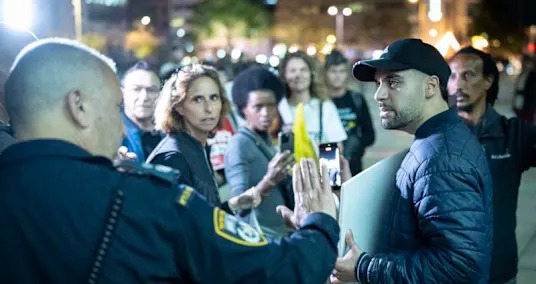
Protests took place in Tel Aviv, Jerusalem, Haifa, and Beersheba, as a survey found broad but uneven support among Jewish Israelis for Operation Roaring Lion.
Israel Police arrested 21 anti-war protesters Saturday night as demonstrations against the conflict with Iran expanded in multiple cities despite restrictions on public gatherings.
Protests took place in Tel Aviv, Jerusalem, Haifa, and Beersheba, with hundreds of participants reported in Tel Aviv and Jerusalem and about 100 in Haifa, marking the largest turnout since weekly demonstrations began. Authorities said 13 people were arrested in Tel Aviv and eight in Haifa.
Police said the gatherings were not approved under Home Front Command regulations that ban events with more than 50 people. Officials said the increase in turnout followed calls by groups opposing the government to protest despite the restrictions.
“During a situation assessment that took place at the scene with a Home Front Command representative… it was clarified that there was a real risk to human life and accordingly, Yarkon [precinct] police commander Tzachi Sharabi ordered the gathering to be dispersed,” police said.
Hadash-Ta’al chairman Ayman Odeh, an Arab lawmaker involved in the protests, criticized the police response, calling officers fascists “in the service of the government” and saying they were afraid of “the heroic citizens who went out, despite everything, to make their voice heard.”

Survey shows broad, uneven support for war
The demonstrations come as a March 2026 survey by the Israel Democracy Institute found broad but uneven support among Jewish Israelis for Operation Roaring Lion. Support was strongest on the Right at 87% and about half on the Left.
The survey also found that Jewish and Arab respondents largely agreed that Iran’s resilience has been stronger than expected. Most Jewish respondents said Israeli society could sustain the campaign for up to one month, while 28% said as long as needed. Arab respondents were less optimistic about how long the public could endure the conflict.
A majority of Jewish respondents said Prime Minister Benjamin Netanyahu’s decision was driven by security considerations, while most Arab respondents viewed it as political.
LATEST POSTS
- 1
 Mom finds out she has cancer after noticing something was off while breastfeeding
 - 2What loving-kindness meditation is and how to practice it in the new year
- 3Mom warns of Christmas gift hazard as daughter recovers in hospital
- 4HGV driver recruited others to smuggle migrants
- 5How to watch 2026 Golden Globe winners like 'One Battle After Another,' 'Adolescence' and 'The Pitt'



- I took my shoes off and went for a barefoot hike. I couldn’t believe what happened next
- 6 Famous kind of practice on the planet
- 4 astronauts are now on their path to the moon. Here’s what happens next
- Step by step instructions to Contrast Lab Jewels and Regular Ones
- Native artists in Texas and Mexico shared their vision of the universe for 4,000 years, ancient murals suggest
- Artemis II live updates: NASA's moon mission breaks Apollo record for farthest distance humans have traveled from Earth
- 10 Setting up camp Shelters That Offer Both Excellence and Isolation
- How to identify animal tracks, burrows and other signs of wildlife in your neighborhood
- Savvy Tips for Seniors Hyundai IONIQ EV